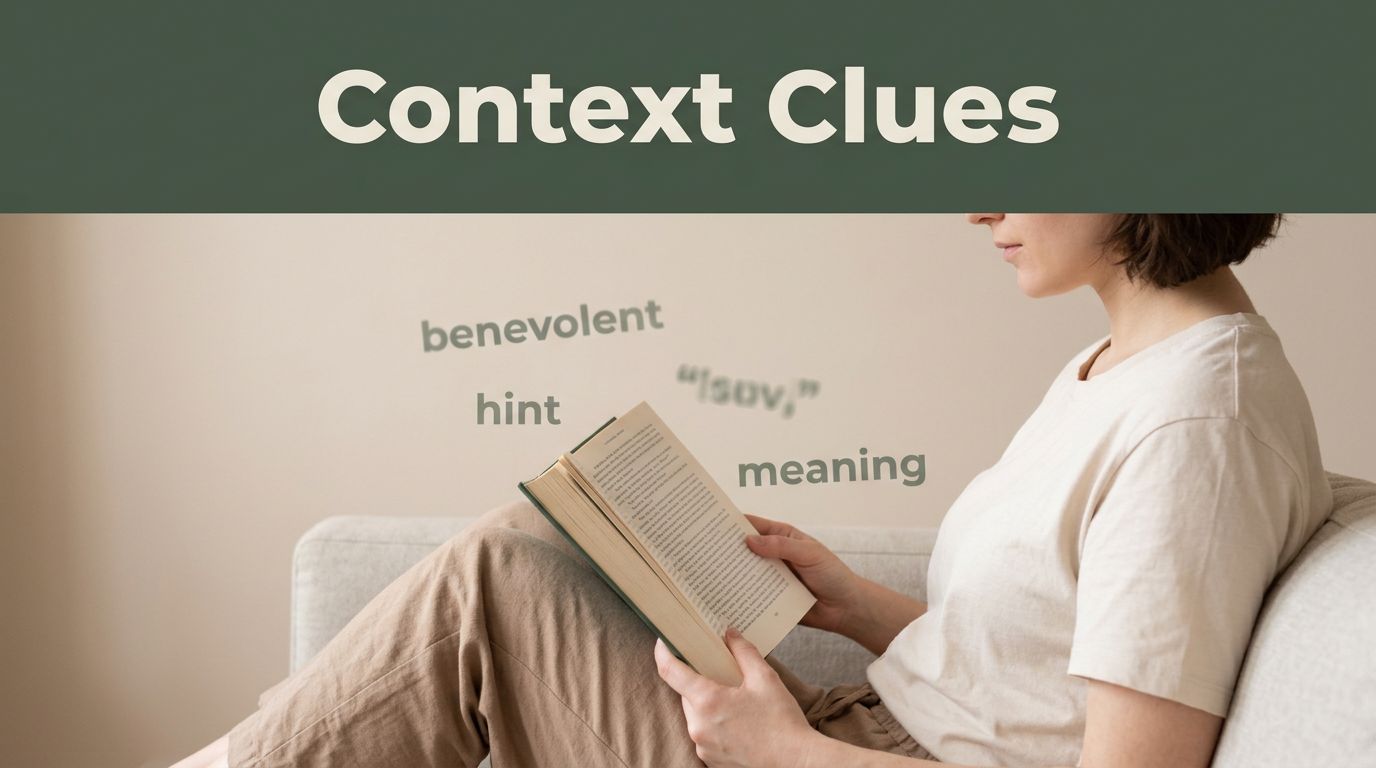
Picture this: You’re deep into a gripping novel, cozy on the couch. Then bam, the word benevolent pops up. You freeze, scratch your head, and wish you had a dictionary handy. Sound familiar?
Don’t sweat it. That frustration hits everyone at some point. But here’s the fix: context clues. These are simple hints in the words and sentences around an unknown term. They let you guess the meaning fast, no dictionary needed.
Why does this skill rock for beginners? First, it builds your vocabulary at lightning speed. You pick up new words naturally as you read. In addition, it boosts your reading confidence big time. No more stopping every page. You’ll crush tests too, since many questions rely on this trick. And in real life? Conversations flow smoother, books feel easier, emails make sense quicker.
This post breaks it all down for you. You’ll learn exactly what context clues are and why they work. Next, spot the five main types, each with clear examples from everyday reading. Then, follow easy steps to apply them like a pro. Practice right away with sample sentences. Finally, sidestep the slip-ups that trip people up.
Get excited. You’re about to turn into a sharp word detective. Let’s dive in and unlock those hidden meanings.
What Context Clues Are and Why They Change Your Reading Game
Context clues act like secret hints right in the text. They come from words nearby, punctuation marks, or even the overall story. These signals help you figure out tough words on the spot. For beginners, context clues turn confusion into quick wins.
Think of yourself as a detective at a crime scene. You spot fingerprints, footprints, and odd items scattered around. Each piece points to the truth. Context clues work the same way. The sentences before and after an unknown word give away its meaning. Punctuation adds extra nudges, like commas that define terms. The big picture of the paragraph fills in gaps too. You solve the word mystery without flipping pages or grabbing a dictionary.
Why do they change your reading game? You read anything without constant stops. Stories flow smooth, and you stay hooked. Your vocabulary grows fast because you learn words in action. Understanding deepens too; plots make sense quicker, characters feel real. In addition, confidence builds. No more stumbling over every new term.
Schools teach this as a core reading strategy. Teachers show kids how to hunt these clues early on. It sticks for life. Take a kid’s book like Charlotte’s Web. Wilbur sees the word humble next to “not showy or proud.” The clue? Simple words around it. He gets it right away. Or in a news article, “The arduous hike tested their limits” follows talk of steep hills and sweat. Tired bodies signal hard work. See how it clicks?
Most importantly, context clues for beginners build habits that last. You tackle books, emails, or reports with ease. Practice them, and reading becomes fun again. Next time a word stumps you, scan around. The answer hides in plain sight.
Spot These 5 Common Types of Context Clues with Real Examples
Now you know what context clues do. So how do you find them? Authors use five main types of context clues to help readers like you. First comes definition clues, where the meaning sits right next to the word. Then synonym clues restate it with similar words. Antonym clues show opposites for contrast. Example clues list items that illustrate it. Finally, inference clues let you guess from the big picture.
These types pop up everywhere in books, articles, and emails. Spot one, and you unlock the word fast. In addition, you stay in the flow of the story. Let’s break down each type. You will get two examples per type, plus tips to use them. Pause before each example to guess the bold word’s meaning. Then check your answer. Practice builds skill quick.
Definition Clues: When the Meaning Appears Right Next to the Word
Authors love definition clues because they explain the word directly. Look for commas, parentheses, or or that set off the meaning. These make it super easy for beginners.
Try this short sentence: “The somnolent cat, or sleepy one, curled up on the mat.” Pause. What does somnolent mean? Right, it means sleepy. The phrase after the comma spells it out.
Now read this paragraph snippet: “She showed philanthropy (love of helping others) by donating to the shelter every month. Her gifts changed lives.” Stop here. Guess philanthropy? It means love of helping others. Parentheses give the direct hint.
These clues help because they leave no guesswork. You get the exact meaning on the spot. As a result, your reading speeds up. Next time you see commas or or, check for a built-in definition.
Synonym Clues: Nearby Words That Mean Almost the Same Thing
Synonym clues use words nearby that say almost the same thing. They restate the idea in the same sentence or paragraph. Spot them when simple words echo the unknown one.
Here’s a quick example: “The arduous hike tired us out. The tough climb left our legs sore.” Think about it. What is arduous? It matches tough, so it means hard or difficult.
Check this longer bit: “He felt elated after winning the race. Joy filled his heart as friends cheered.” Pause and guess elated. Yes, it means joyful or very happy. The synonym joy confirms it.
Why do these clues rock? They build connections between words you know and new ones. Therefore, your vocabulary grows without effort. Scan for restatements, and you nail the meaning every time.
Antonym Clues: Opposites That Stand Out with Words Like ‘But’
Antonym clues shine through opposites. Words like but, however, although, or unlike signal contrast. They make the unknown word clear by showing what it is not.
Test yourself: “The frugal shopper saved money, unlike her spendthrift friend who bought everything.” What does frugal mean? It opposes spendthrift, so frugal means thrifty or careful with money.
Read on: “Not timid at all, the valiant knight faced the dragon. He charged forward with sword raised.” Guess valiant before peeking. It means brave, the opposite of timid.
These help big time because contrasts stick in your mind. You remember valiant as not timid. In addition, they appear often in stories with character differences. Watch for but or unlike, and flip the meaning.
Example Clues: Hints from ‘Such As’ or ‘Like’
Example clues give lists or illustrations. Phrases like such as, like, or for instance introduce hints. They show what the word covers.
Quick one: “Edible plants, such as apples and carrots, grow in the garden.” Pause. What fits edible? It means safe to eat, like those fruits and veggies.
Longer example: “The zoo displayed aquatic creatures like fish, dolphins, and seals. They swam in huge tanks filled with saltwater.” Think it over. Aquatic means living in water.
You win with these because examples paint a picture. Suddenly, aquatic clicks through fish images. Also, lists make abstract words concrete. Next time such as shows up, match the items to the word.
Inference Clues: Guessing from the Overall Picture
Inference clues hide in the sentence vibe or logic. No direct words here. Instead, the whole context reveals it. You piece together details like a puzzle.
Simple start: “The deluge soaked everyone at the picnic. Tables flipped, food floated away.” Guess deluge. It means heavy rain or flood, from the wet chaos.
Deeper paragraph: “The chef garnished each plate with care. He added lemon twists and herb sprigs just so. Diners raved about the pretty food.” What is garnished? It means decorated, based on the details.
These build your brainpower most. You learn to read between lines for real-world texts. Besides, they appear everywhere, from news to novels. Trust the surrounding story, and you guess right. Practice inferences, and no word stumps you long.
Follow This Easy 4-Step Process to Decode Any Unknown Word
Ready to put those five clue types to work? This simple four-step process turns you into a word-decoding pro. Beginners love it because it works fast, about 80% of the time on first try. You apply the definition, synonym, antonym, example, or inference clues without guessing blindly. Best part? It fits any text, from novels to news. Follow these steps in order each time a word stumps you. You’ll read smoother and build skills quick.
Step 1: Read the Full Sentence or Paragraph First
Start big picture. Read the whole sentence or paragraph before zeroing in on the unknown word. This grabs the main idea so clues stand out.
Don’t just stare at the tough word alone. That isolates it and hides hints. Instead, get the flow first. For example, if a story talks about a rainy day ruining plans, words like “soaked” and “puddles” set the scene. Now any flood-related term makes sense. As a result, your brain connects dots easier. You spot clue types right away because context lights them up.
Step 2: Hunt for Familiar Words and Clue Signals
Scan for words you know around the unknown one. Look for signal phrases that scream clue types. These point straight to the meaning.
Familiar setups include or or commas for definitions, restatements for synonyms, but or however for antonyms, such as or like for examples. Inference clues hide in the overall logic or tone. Jot quick notes on what you find. For instance, spot unlike? Expect an antonym contrast. Or see a list after for example? Match it to examples. This hunt ties back to the five types without effort. Therefore, you narrow options fast and stay confident.
Step 3: Make a Smart Guess Based on the Hints
Pull all clues together now. Predict the word’s meaning from signals and familiar words. Keep your guess simple at first.
Act like a puzzle solver. Combine hints for the best fit. Here’s practice: “The voracious eater finished three pizzas alone. Everyone stared in awe.” What jumps out? “Finished three pizzas” suggests huge appetite, so voracious means very hungry. Tie it to example clues here. Your guess strengthens because clues overlap. If stuck, ask yourself what fits the main idea. Most times, this step nails it.
Step 4: Test Your Guess in the Sentence
Plug your guess back into the sentence. Read it aloud. Does it flow and match the sense?
Replace like this: Change “voracious eater” to “very hungry eater.” Perfect fit? You’re done. If it clunks or shifts meaning, reread steps two and three. Hunt missed signals or tweak the guess. For example, wrong fit might mean you overlooked an antonym but. Test again until smooth. This seals the deal 80% faster than dictionaries. Practice often, and it becomes automatic. Now tackle any text with ease.
Hands-On Practice: Test Your Skills with These Sentences
You’ve got the types down and the steps locked in. Now put it all to work. These ten original sentences mix up the five clue types. Read each one carefully. Pause to guess the bold word’s meaning on your own. Then check the reveal right below. Cover it with your finger if you want a true test. Ready? Let’s go.
First sentence: The loquacious student, or one who talks a lot, dominated the class discussion all hour. What pops into your head for loquacious?
Reveal: It means talkative. This definition clue spells it out with “or one who talks a lot” after the comma. Spot those direct explanations next time.
Next up: She displayed magnanimity by forgiving her rival. Her generosity touched everyone in the room. Guess magnanimity before peeking.
Reveal: It means generosity. A synonym clue here, since generosity restates the idea nearby. Simple words like that bridge the gap fast.
Try this: The gregarious host loved parties, but his shy brother hid in the corner. What does gregarious suggest?
Reveal: It means sociable or outgoing. The antonym clue jumps out with but, contrasting the shy brother. Opposites make meanings crystal clear.
Here’s another: Nocturnal animals, such as owls and bats, hunt when the sun sets. Think about nocturnal.
Reveal: It means active at night. Example clues shine through such as, listing night hunters to illustrate. Those lists paint the picture quick.
Now shift gears: The cacophony of horns and shouts filled the busy street. People covered their ears from the awful noise. Guess from the scene.
Reveal: It means harsh noise or racket. Inference clues build from the whole picture; the covered ears and shouts point to loud chaos. Piece it together.
Keep going: He showed candor (complete honesty) during the job interview. His answers impressed the boss. What fits candor?
Reveal: It means honesty. Definition clue again, with parentheses giving the straight meaning. Authors tuck these in often for beginners.
One more synonym: The obstinate child refused to eat veggies. The stubborn kid crossed his arms tight. Predict obstinate.
Reveal: It means stubborn. Synonym clue restates it directly with stubborn. Echoes like that strengthen your guess every time.
Antonym time: “Not weak, the stalwart athlete lifted the heavy barbell with ease.” Flip the contrast for stalwart.
Reveal: It means strong. Antonym clue via “not weak” sets up the opposite. Words like not signal these flips reliably.
Examples next: The garden bloomed with perennial flowers like roses and tulips that return each year. Match perennial.
Reveal: It means lasting multiple years. Example clue uses like to show flowers that come back. Real items make it stick.
Final challenge: Rain poured in a torrent, turning paths into rivers. Kids splashed in the sudden flood. Infer torrent.
Reveal: It means heavy downpour. Inference from the flooding paths and splash; the overall wet mess reveals it. Trust the story vibe.
How did you do? Nail eight or more? You’re crushing it already. Miss a few? No big deal; reread the types and try again. Now grab your current book, article, or email. Hunt for one context clue per page. Spot the type and guess the word. You’ll see them everywhere soon. Keep practicing, and unknown words won’t slow you down.
Pitfalls to Skip: Common Errors and Quick Fixes
You’ve practiced hard, but even sharp readers slip up sometimes. We’ve all done this! Beginners often miss easy fixes because small habits trip them. Don’t worry. Spot these four common errors now, see a wrong guess example, and learn the quick step-by-step repair. You’ll dodge them next time and read smoother. As a result, context clues click faster.
Ignoring Punctuation: Missing Commas and Parentheses
Punctuation shouts clues, yet folks skip it. Commas or parentheses often hold definitions. You read past them and guess wrong.
Take this: “The ebullient crowd, full of excitement, cheered loud.” Without commas, you might think ebullient means noisy. Wrong guess: loud.
Fix it quick. Follow step one: reread the full sentence. Step two: hunt signals like commas. They flag a definition. Step three: guess excited from “full of excitement.” Step four: test it. “Excited crowd cheered” fits perfect. Now punctuation pops every time.
Sticking to One Clue Type: Overlooking Mixed Hints
You spot a synonym and stop. But clues mix, so you miss the full picture. This leads to half-right guesses.
Example: “Resilient kids bounced back fast. Tough and quick to recover, they played on.” You grab tough as synonym and guess strong. Close, but ignores examples.
Repair follows steps. First, read whole thing. Next, scan all signals: synonym plus examples like “bounced back.” Guess able to recover. Test: “Recovering kids played on.” Spot-on. In addition, check multiple types always.
Overthinking Simple Words: Turning Easy into Hard
Newbies complicate basics. A plain word stumps you because you hunt fancy clues. Therefore, you invent wild meanings.
Here’s one: “The meager meal left her hungry. Just bread and water.” You overthink, guess fancy or rare. Wrong.
Undo it simply. Step one: full context shows little food. Step two: inference from “left her hungry.” No need for more. Guess small or tiny. Test fits smooth. Keep it basic; stories stay real.
Rushing the Test: Skipping the Plug-In Check
You guess fast and roll on. Without testing, wrong meanings sneak in and confuse later paragraphs.
Try: “Pernicious weeds killed the flowers. They spread and choked everything.” Quick guess: pretty. Plot crashes ahead.
Bounce back with steps. After guessing harmful, plug in: “Harmful weeds choked.” Flows great. If not, revisit clues. This seals guesses solid. Practice stops the rush.
Catch these slips, and you’ll fly through texts. You’ve got this down now.
Conclusion
Context clues empower you to tackle unknown words anywhere you read. You now spot the five main types, from definitions to inferences, with real examples that stick. Most importantly, the four-step process makes decoding fast and reliable.
Practice turns these skills into habits. You read full sentences first, hunt signals next, guess smart, then test the fit. As a result, books flow without stops, and your vocabulary grows every day.
Grab a book or article today. Try the process on three words, then share your funniest wrong guess in the comments below. Bookmark this guide for test prep too. You’re now equipped to read like a pro.